My tweets of the last week:
What I Tweeted, 2010-07-12 Edition
My tweets of the last week:
What I Tweeted, 2010-07-05 Edition
My tweets of the last week:
Indie TiMER gets RomCom formula right, sans formula
Most romantic comedies are neither romantic nor a comedy.
Discuss.
Really, is there much romance in watching two highly paid stars drift together over the course of two hours? And, are the situations ever truly funny, rather than simply awkward?
I don’t watch RomComs for those very reasons – they emphasize wattage over chemistry, and winces over laughter. My own life is more romantic and comedic than most movies in the genre.
None of that is true for TiMER, a beautiful, witty, indie flick full of love and laughter. It’s a romantic comedy through and through, but it hardly delves into the pedestrian trope of most RomComs thanks to its clever titular premise.
 A near neighbor to Eternal Sunshine of the Spotless Mind and similar to the quirky premise of How I Met Your Mother, TiMER is speculative fiction without the ray guns or alien races. It depicts an alternately reality only a shade different from our own, where science has found a way not only to divine your soul mate, but to define the exact day you’ll first meet them.
The process is simple. Visit a TiMER storefront (as ubiquitous as a cell phone store) and have a small digital screen implanted into your wrist. Your screen will count down to zero: the day you meet your true love.
It sounds ideal – you’ll know exactly when the one is really the one; no more worrying you’ll die alone or dating your way through losers.
Right?
Step-sisters Oona (Emma Caufield) and Steph (Michelle Borth) are a microcosm of why finding the one isn’t as simple as science. Oona’s TiMER won’t start counting down, while Steph’s is ticking towards a date in the far-flung future. And their little brother, barely old enough to have the device installed, gets an unexpected result.
Are any of the three situations better than going on blind dates, or having unrequited crushes? Both disappear from life when finding your soul mate is a matter of waiting for a special ring tone, which explains why many people in the world of TiMER go defiantly bare-wristed. Otherwise, romance would be extinct – no more courting, or transforming from friends into lovers. At least, not if you’re hoping it will last forever.
Emma Caulfield, most known for portraying the daffy, rabbit-fearing, reformed-demon Anya on Buffy the Vampire Slayer, carries the film with comedic aplomb. It’s surprising to see her take center stage so handily after watching her as an ensemble player.
Caulfield is just neurotic enough to come off normal, an orthodontist on the verge of 30 who is beginning to worry that it’s her that’s defective rather than her timer. Her typical zaniness is dialed down, leaving her sympathetic and vulnerable as the lovelorn Oona.
Similarly, Michelle Borth plays what could have been a flat depiction of promiscuity as an exercise in ethics. She portrays Steph as smartly self-aware instead of simply slutty (while remaining an utter bombshell). If your true love is years away, why not enjoy yourself with no strings attached with others in the same situation?
The rest of the supporting cast is strong, especially romantic foil John Patrick Amedori, exuding magnetic charm from his first line, and the rest of Ooma and Steph’s extended clan.
The movie wisely plays fast and loose with its science – in lieu of special effects and lengthy expositions it wields a script that injects reality into an unreal situation. The workings of the central device are left largely unexplained and to the viewer’s imagination, leaving room to speculate around the main story.
TiMER finds a way to inject romance into a world supposedly devoid of it, and stays comedic throughout. It’s also the first film so wistfully romantic that I was driven to actually hold my wife’s hand at the climax.
Highly recommended.
TiMER is currently showing in limited release, and is also available for streaming via Netflix.
Disaster is Natural
I have this theory about how Philadelphia is immune to disaster.
Stick with me for a minute.
No seismic activity. Relatively far away from potential tidal waves and protected from hurricanes. We’re not known for forest fires or mudslides, and despite our utter flatness occasional floods are minor. It doesn’t get too oppressively hot and the biggest challenge in our snow storms is waiting for the city to send plows. We’re relatively drought- and famine-proof, as modernized cities go, and NYC and DC are preferable targets for terrorists and rogue nuclear missiles.
Really, the closest we come to city-wide disaster is one of our sports teams winning a championship. Otherwise, short of OCD Godzilla bursting free from my chest to tramp around Center City, it’s a pretty safe place to live.
So, of course we move out of the center of the city to the fringes and within the first week there’s a tornado on our block.
Yes, day six as homeowners, tornado.
That is only vaguely an exaggeration. It wasn’t officially a tornado, and it was actually on pretty much every block adjacent to our new one while leaving us untouched.
I witnessed a portion of the storm from my office window, and it looked sufficiently deadly – I saw it blowing things clear off the gated roof of an adjacent building before my view was reduced to a foggy blackout. However, when I left, Center City looked no worse for the wear.
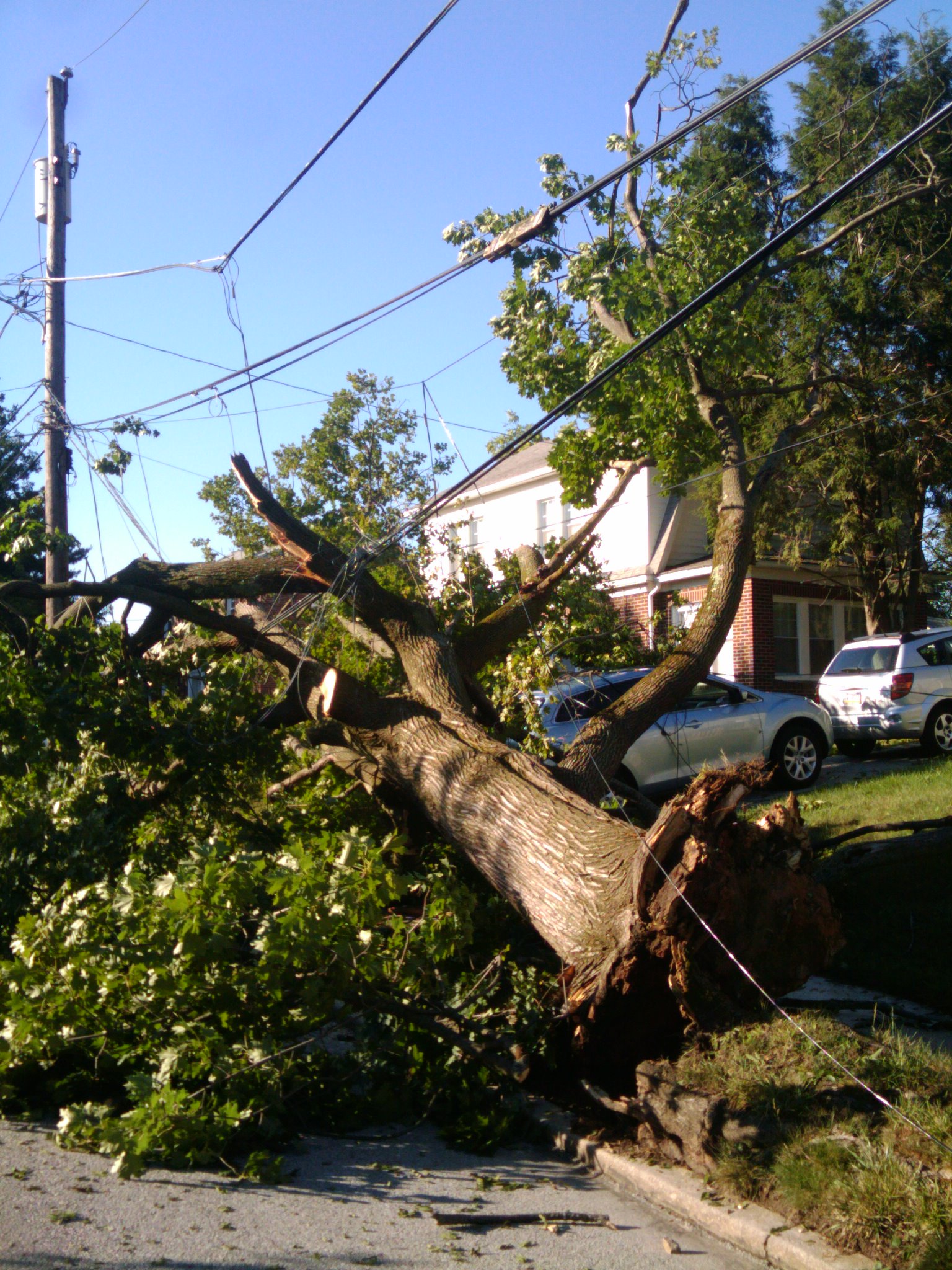
A huge tree on the next block, completely uprooted.
My new neighborhood was a different story. My bus stopped a mile short of our house in traffic snarled by dark traffic lights.
I disembarked and began a muggy hike back to my home. About a mile out from our house I started to see down tree branches. Then it was downed tree limbs, taking some power lines with them.
By the time I was a block away it was entire trees – trunk, roots, and all, upended ass over end to be splayed rudely across well-groomed lawns. Entire blocks of entire trees, the entire landscape denuded by mother nature.
To say I was nervous when I approached our house would be an understatement. I was obsessing over the huge tri-trunked tree that shades our patio, and how any of its trio of arms could go crashing through the roof to destroy my collection of guitars and recording equipment, now located in one conveniently destructible place.
My heart sank when I turned onto my street a block below our house, only to find it completely blocked off by the arboreal carnage.
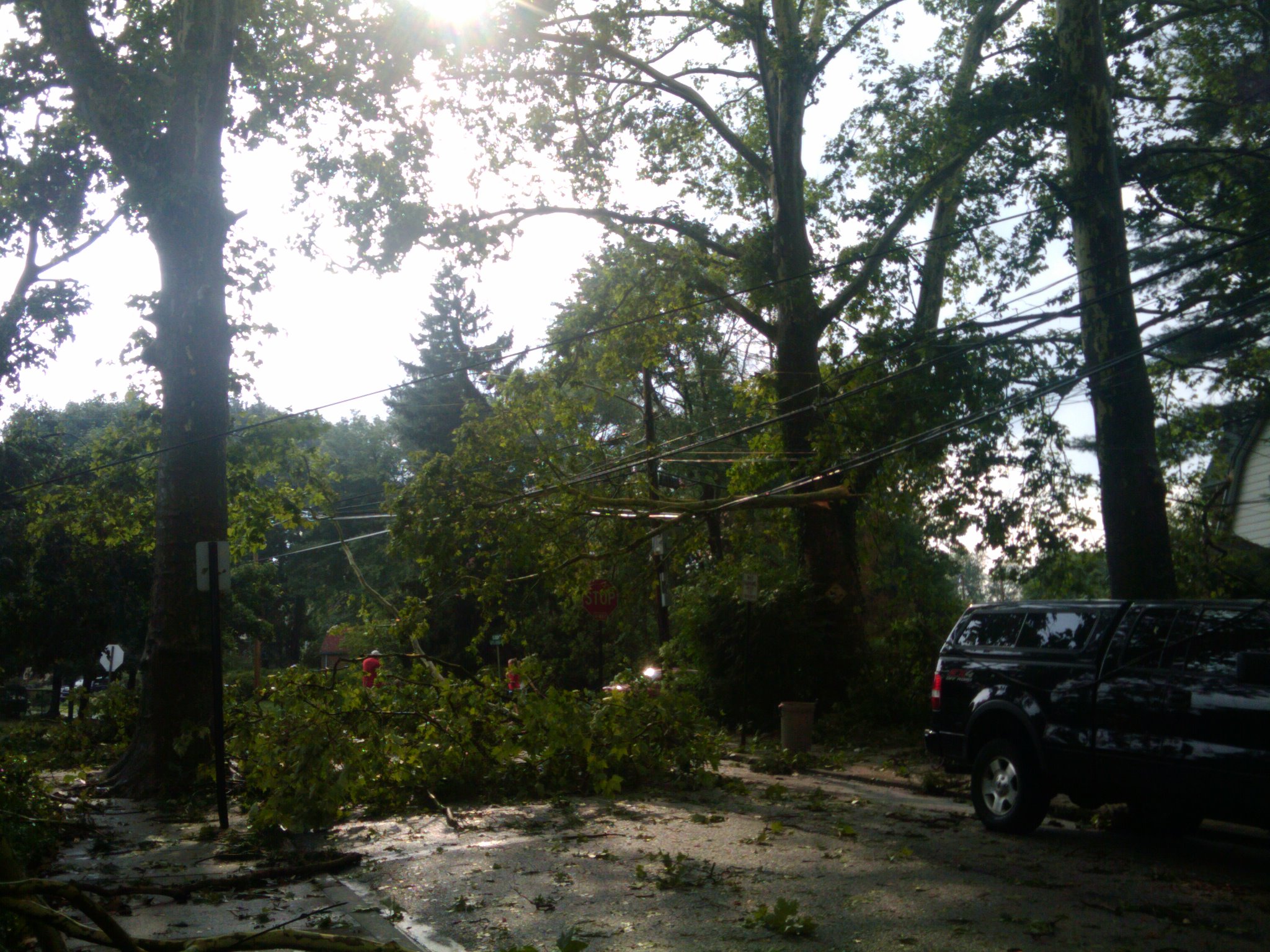
A barricade of branches and power lines.
Having lived in the absence of disaster for nearly three decades, to me the sight was fantastical – as if my block had experienced some sort of wizarding dual, the debris glinting with hints of magic in the afternoon sun.
I navigated around it with great care, emerging on the other side to regard a pristine, untouched block stretching beyond the mess.
I raced the remaining distance to my house but, like the rest of our block, it was unmolested – no downed trees, no holes in our windows from golf-ball-sized hail. The only evidence of a storm my neighbor described as sounding “like a freight train passing by” was a dusting of shredded leaves on our lawn and our power, out.
We dodged a bullet – a house on the next block had its gutters shredded by downed trees, while a few streets over a massive branch decimated the windows of an SUV. A co-worker lost all of the power lines to his house to trees.
Us, we just lost our innocence – no longer protected from disaster by Philly’s impregnable grid of row homes, and now inclined to worry about the state of our house after every storm.