To view this content, you must be a member of Crushing Krisis Patreon
 Unlock with Patreon
Already a qualifying Patreon member? Refresh to access this content.
Comic Books, Drag Race, & Life in New Zealand
 As a music fan, consumer, and review, it’s hard for me to detach my reaction to a new album from the expectations game.
That’s especially true of fourth albums, like Adele’s 30.
Everyone loves an indelible debut record. When we love an artist’s first album, we fall in love with the songs, but we’re also deeply curious about their potential. What path will they take? How will their follow-up sound?
We applaud when an artist releases a strong second album. We are amazed when it is even better than the first. When we love an artist’s second album, we fall in love with the songs, but we’re beginning to measure a vector. They’ve moved in a direction, even if that direction is to provide more of the exact same. Will they continue to progress in that same way?
Third albums are tricky. That’s when things become interesting. Third albums are when we think we really know something about an artist. We have a reasonable sample size of songs. We have three points from which we can triangulate position and estimate future progress.We can say, “the artist usually does this or that.” We can decide if their progression has been linear or if it took a hard turn into unexpected territory.
That is why fourth albums are dangerous. They are the realm of proving or disproving all those things that we thought we understood. They have the potential take an artist’s progression from a line – or even a triangle – to some wild uneven quadrilateral that might even intersect with itself. They’re often the moment where an artist solidifies who they really are and who they will continue to be for many years to come.
I think most people navigate that musical map subtly. Unconsciously. The average listener has some expectations that might be fulfilled or shattered, but I don’t think they consider a fourth album to be particularly significant.
I’m not like that. I can’t turn off the part of my brain that dissects songwriting and production, and that draws out vectors of musical style and influences. I am graphing each release as a point on a musical map and drawing the vectors between them. I can’t help it.
Adele has had a textbook progression through these first three steps Memorable debut? Check. Explosive classic sophomore effort that raised her to worldwide acclaim? Check. Stylistically rangy third record that at once confirmed her strengths but pushed some of her boundaries. Check.
Now, 11 years after her debut but a whole 6 after her third record, we’re getting that fourth album. The dangerous one. It’s dangerous for Adele, but dangerous for me, too – because I feel the weight of all of those expectations.
I had to listen to it two different ways. First, just to hear the songs. Then, to hear them with the weight of all of that piled on top of them.
It was terrible both ways, which leaves me fearful of Adele’s future trajectory.


Adele is the biggest blockbuster voice in popular music today, both in spectacle and in sales. That makes any album of hers a hotly anticipated release. 30, in particular, has been inflated even further. The first in six years! The first since she got divorced! Got thin! And it’s accompanied by a pair of pan-Atlantic concert specials! And an interview with Oprah!
I don’t know that the spectacle could get any bigger. It threatens to overshadow the features that made Adele so famous in the first place: her massive voice, her clear-eyed songwriting, and her biting sense of humor.
Adele is famous for using that massive voice to command attention on her emotional ballads just as well as she uses it to power surprising, genre-defying pop hits like “Chasing Pavements” and “Rolling in the Deep.” She has never lacked for strong material in either category. Her songwriting skills are as notable as her vocal power, even if her vocals sometimes overshadow them.
Now at a pinnacle of her popularity, 30 finds Adele coasting through a set of charmless songs without an earworm refrain to be found. Suddenly, she is putting the schmaltz at center stage rather than her songwriting acumen. I don’t begrudge her the sales, but I wish they came with a more enjoyable record. [Read more…] about 30 – Adele | the expectations game
 Welcome back to Crushing Comics Book Club for Batman by Grant Morrison! This is the second of three episodes of pre-reading to catch up on some of the themes, characters, and influences on Morrison’s run.
In this episode, we read the first 2/3rds of the Tales of the Demon TPB, which includes the debut of Talia al Ghul and R’as al Ghul. We didn’t know what to expect from these Bronze Age stories, but we wound up falling in love!
Harry is our expert – he loves Batman and Morrison, and he has read this run multiple times. Fariha is our intermediate – she has read plenty of Morrison and DC. And, Peter is now the novice – he’s read some of this run before, but otherwise this is his FIRST TIME reading pre-New-52 Batman!
The stories are:
Tune in next week as we wrap up our pre-reading by finishing the final four issues in Tales of the Demon, as well as the Demon Trilogy of Son of the Demon, Bride of the Demon, and Birth of the Demon.
Want to subscribe? You can find us on our RSS feed, Spotify, Stitcher, PodChaser, Apple Podcasts, and Podcast Addict!
This is available to everyone, but it was made possible via the support of Patrons of Crushing Krisis:
The Revised & Expanded X-Men Reading Order Guide – Era #2: Second Genesis

Now that I’ve re-read all of the X-Men Classic back-up stories and Marvel Team-Up issues as part of our Epic X-Men (re)Read, I had some adjustments to make to this guide. I also rebuilt my reading order database, which allowed me to catch some stray appearances mentioned in the comments of the page.
I think the most-significant change to this reading order is that I’ve promoted a handful of Iron Fist and Marvel Team-Up issues to be required reading from being optional, since they were written by Claremont and fill in actions and relationships referred to later in the main Uncanny run.
Updated Feb 17, 2025. The definitive, chronological, and up-to-date guide on collecting X-Men Age of Krakoa, including X-Men flagship titles by Jonathan Hickman, Gerry Duggan, Kieron Gillen, & Al Ewing, in comic books via omnibuses, hardcovers, and trade paperback graphic novels. A part of Crushing Krisis’s Crushing Comics. Last updated February 2025 with titles scheduled for release through September 2025.

Comics mega-star Jonathan Hickman took over the X-Men franchise as both a writer and “Head of X” in July 2019, and since then nothing has been the same.
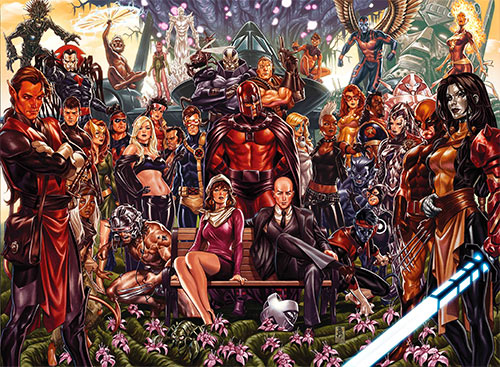 That’s not the only reason 2019 was a historic year for the X-Men. As a film media property, the rights to X-Men returned to the Marvel fold when Disney acquired FOX in March of 2019.
Certainly, this change to the licensing of Marvel’s Merry Mutants had an effect on the potential for massive comic plots to return to the somewhat languishing X-line. By many accounts, Hickman and his massive pitch for a massive shift in status quo for the X-Men had been around for some time in the X-Office during All-New All Different Marvel and RessurXion.
Even knowing a major change was coming to the X-line couldn’t prepare readers for what Jonathan Hickman had in store. He launched his era with a pair of intertwined mini-series – House of X and Powers of X, widely abbreviated as HOX and POX or HOXPOX – both filled with major bombshells of plot. Hickman revised the history of several characters in a major way that will forever color re-reads of classic material, and he used that change to set up an utterly shocking set of present day circumstances for the mutant race.
From the conclusion of HOXPOX, Marvel launched an initial line of six ongoing comics – a flagship X-Men title from Hickman, and five supporting books.
Marauders by Gerry Duggan was the most integrated with elements introduced by HOXPOX. Excalibur by Tini Howard used a newly-available character to spin new continuity about mutant magic. New Mutants by both Hickman and Ed Brisson examined the younger generation of mutants as evangelists to stray members of the mutant race. X-Force by Benjamin Percy looked at the security of the new world of mutants, both internally and externally. Fallen Angels by Bryan Edward Hill was the one fizzled launch book – it tried to integrate Kwannon into the new status quo, but stumbled along the way.
After the initial wave of books, early 2020 brought a new wave of ongoings and mini-series – as well as a replacement for the canceled Fallen Angels with Hellions by Zeb Wells following Kwannon’s continuing adventures. Notable, X-Factor by Leah Williams addressed one of the core concepts of Hickman’s new status quo for mutants.
Marvel Comics, along with most other publishers, paused their physical releases starting in late March of 2020 due to the global pandemic. This pushed back the first major event of the Hickman era to begin in September. X of Swords was a massive 22-part direct crossover through all of the ongoing books in the line pulled together plot threads from Hickman’s flagship as well as Howard’s Excalibur. It addressed virtually no plots outside of that, though it would certainly have an effect on all of the books coming out of the event.
After X of Swords, a third wave of new books launched in late 2020 and 2021, including one directly out of the event – Al Ewing’s S.W.O.R.D.. That wave of books largely concluded at the end of 2021 alongside the end of Hickman’s time on Krakoa with Inferno (2021).
Then, after a poorly-received band-aid event (X Lives/Deaths of Wolverine) to give the line time to reorient without Hickman, 2022 saw the launch of additional flagships in Kieron Gillen’s Immortal X-Men (focused on the Quiet Council) and Al Ewing’s X-Men Red (focused on Storm on Mars). Just a few months into both titles, they converged for the tightly-coordinated linewide Avengers / X-Men / Eternals: Judgment Day event, which was more than 50% written by Gillen on his own!
The line continued its three-flagship era into 2023, adding a number of five-issue limited series alongside the long-running Ben Percy titles of X-Force (2019) and Wolverine (2020). Then, halfway through 2023, the Hellfire Gala significantly altered the line and sent it into the “Fall of X” – again spawning a number of short-running limited series. After the first six months of Fall of X, the line moved on to its six month finale with the tightly-coordinated Fall of the House of X / Rise of the Powers of X.

[Read more…] about X-Men, The Age of Krakoa (2019 – 2024) – The Definitive Collecting Guide