 X-Men is one of the most popular comics franchises in history, and in the 90s it rode the crest of the speculator wave to over half a dozen ongoing series and at least twice that many crossover events.
However, when it comes to coverage in oversize editions, you’d think that those crossover events were all there was to X-Men in the 1990s. That’s not the case, and there are hundreds of issues outside of those events that haven’t seen oversize collection – including many that have never been reprinted.
Every one of those issues is covered in this post. Why? To give you ideas for the The Most Wanted Marvel Omnibus Secret Ballot, where you vote for the comic runs you’d most like to see in an oversized format. Yesterday I covered all of X-Men from 1963 to 1991 and how it could be collected by omnibus volumes, and tomorrow I’ll be back to cover the Morrison and Whedon era of X-Men.
 There are 28 potential omnibus volumes in this material! Collected Edition mapping is a trivial pursuit (in both senses of the phrase) that is up to a lot of personal interpretation, so if you have a correction or disagreement don’t hold back – sound off in the comments below!
I think of this era as everything from X-Men #1 and Uncanny X-Men #281 in 1991 through the end of Onslaught and continuing to the beginning of Grant Morrison’s take on the X-Men in 2001. We’ve already got a number of omnibus-sized oversize hardcovers clustered at the beginning of this era, but after Age of Apocalypse things get spotty across all of the titles.
Are you ready? (I’m not sure that you could possibly be ready.)
- Uncanny X-Men & X-Men, Vol. 2
- Part 1: The Crossover Era (Uncanny X-Men #281-337 & X-Men, Vol. 2 (1991) #1-57)
- Part 2: The Big Gap (Uncanny X-Men #338-393 & X-Men, Vol. 2 (1991) #58-113)
- X-Factor (1986) #71-149 & Mutant X (1998) #1-32
- Wolverine (1988) #58-189
- Excalibur (1988) #68-125
- X-Force & Cable: X-Force (1991) #32-115, Cable (1993) #9-107, & Soldier X (2002) #1-12
- Generation X (1994)
- Miscellaneous X-Men
 Past is prologue. We’ve seen it before, so we know what we’ll see. And, like in the rest of life, we’re pleasantly surprised when we get something truly novel…
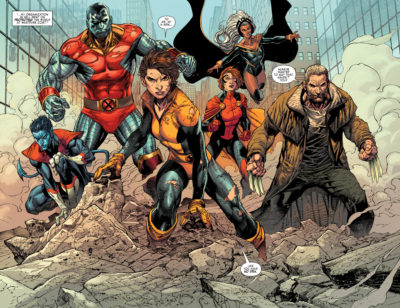
 Written by Marc Guggenheim with pencils by Ardian Syaf, inks by Jay Leisten, colors by Frank Martin, and letters by VC’s Cory Petit.
 as a studied X-fan of over 25 years. I’m all for continuity-dense mining of years of history, but Guggenheim -the successful creator of CW’s Arrow – was wise enough to know now isn’t the time.


 Stan Lee and Roy Thomas had established the allegory of Xavier’s closed hand approach to leading mutants versus Magneto’s closed fist long before Chris Claremont first penned the character in 1975. Magneto transform from a one-note villain in X-Men #1 in 1963 to a man blinded by the frenzy of needing to defend his own people by either establishing a sovereign nation for them or bending the entire world to his will.
 It seems that the land is cursed with ill intent, and Magneto couldn’t escape that when a super-sentinel cuts him and his millions of subjects down in cold blood in the shocking opening scenes of Grant Morrison’s New X-Men. Yet, Claremont would find a way to cheat that death (after all, it’s his speciality) in a 2004 iteration of Excalibur, using Magneto as leverage to kick off the House of M event.