• Skip to primary navigation
  • Skip to main content
  • Skip to primary sidebar

Crushing Krisis

Comic Books, Drag Race, & Life in New Zealand

  • DC Guides
    • DC Events
    • DC New 52
    • DC Rebirth
    • Batman Guide
    • The Sandman Universe
  • Marvel Guides
    • Marvel Events
    • Captain America Guide
    • Iron Man Guide
    • Spider-Man Guide (1963-2018)
    • Spider-Man Guide (2018-Present)
    • Thor Guide
    • X-Men Reading Order
  • Indie & Licensed Comics
    • Spawn
    • Star Wars Guide
      • Expanded Universe Comics (2015 – present)
      • Legends Comics (1977 – 2014)
    • Valiant Guides
  • Drag
    • Canada’s Drag Race
    • Drag Race Belgique
    • Drag Race Down Under
    • Drag Race Sverige (Sweden)
    • Drag Race France
    • Drag Race Philippines
    • Dragula
    • RuPaul’s Drag Race
    • RuPaul’s Drag Race All Stars
  • Contact!

topics

protagonists, plot armor, and diversity in fiction

July 8, 2016 by krisis

There is no question in my mind that diversity of representation in fiction is important, and not just because EV naturally gravitated towards female heroes as a baby.

The media we consume helps to construct the reality we assume, which is highlighted by one of my favorite communication theories, Cultivation Theory. It’s a pretty obvious theory at its root – if all we see on the news are stories about muggings and murders, we assume the world around us is disproportionally unsafe. We cultivate our perceived reality from the media we consume.

Similarly, I think if we consume fictional worlds where we see ourselves reflected we are emboldened, and when they are filled with people different than ourselves, we come to hope and expect our lives will be filled with those people, too.
MAvgV02 - 0001 epting variant promo

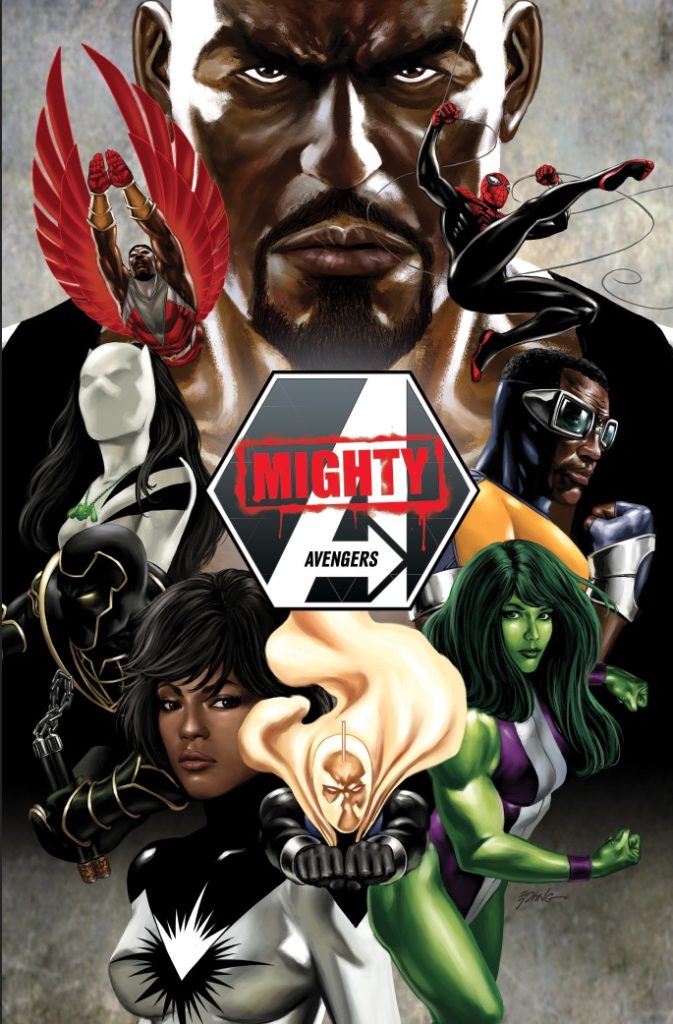
Marvel relaunched Mighty Avengers in 2014 as a majority POC team of Avengers. Art by Steve Epting.

That means all representation is good representation, like Riri Williams as Iron Man, but having a diverse cast is just step one of a truly representative fictional world. Step two is how you treat those characters and who among them gets to be the protagonist.

One of the challenging aspects of being the author to construct those worlds is putting your cast of diverse characters into perilous situations. For a story to be thrilling – especially a story serialized in the long term – we have to believe that characters are truly in danger.

This is part of what makes an auteur like Joss Whedon so compelling (and so maddening): with him, everyone is in danger, all of the time. There is no status quo. Of course, comic books embrace this concept wholeheartedly –  nothing thrills them like making the transgressive choice of killing the seemingly unkillable (only to bring them back to life later). It’s no coincidence Whedon was a comic fan before he was famous (he’s said many times Buffy was based on the template of Kitty Pryde).

(I don’t mean to deify Whedon, as he has his weaknesses from the critical lenses of feminism or queer theory (the two I feel somewhat qualified to speak to), but he is easily the best mainstream male creator to use as an example here – and not just for his visibility. The fact of the matter is, he’s willing to kill popular white guys and let women win. That’s a start.)

Is killing more characters more often the best method of making a story with a diverse cast more thrilling? Not really, because that doesn’t fully recognize the problem of protagonists and plot armor, among other reasons.

The protagonist of a serialized story tends to wear some unavoidable amount of plot armor – a form of extra-fictional protection derived from the fact that we know they will be in the commercial for the next installment. They might be injured or tortured, or even killed in the long run, but they don’t tend to die in random, unhyped episode.

(Many forms of episodic fiction use this to their advantage, setting up a fake set of protagonists to off shockingly early. I can only think of one that legitimately killed main characters left and right at all times: Spooks AKA MI:5 from BBC. Be warned – you are going to be upset when you watch it.)

To make the world around the protagonist seem like it has some amount of stakes, it is the supporting cast who must go without plot armor to be placed in peril. Thus, if the only diversity in your fictional world is in the supporting cast, then your diversity tends to be expendable. If they aren’t, it feels like they are also are wearing “plot armor,” and now your fiction has no consequences.

The unfortunate result of this is that the people who need to see themselves represented more in heroic fiction – people who are black, indigenous, Asian, LGBT, female, disabled, and on – also wind up seeing themselves maimed and killed to make their protagonists feel something and to give their world the illusion of danger.

(The disposal of supporting female characters to make male protagonists feel was deemed “fridging” or “Women in Refrigerators” by then-critic/now-author Gail Simone. At this point, “fridging” is a more generalized term applied to the suffering of any (typically minority) character in order to create a reaction in the (typical male) protagonist.)

There’s a deeper vein being tapped here than simply the expectation that these characters will be endangered. There is also the risk that readers begin to see those grim fates as inextricably tied with their identities. A great example that isn’t tied exclusively to identity is the horror movie trope that the girl who has sex is sure to die. The implication (sometimes intentional, sometimes not) is that sex is sinful and it makes you narratively expendable (or, worse, a target for violence).
YAvgV02 - 0013 promo

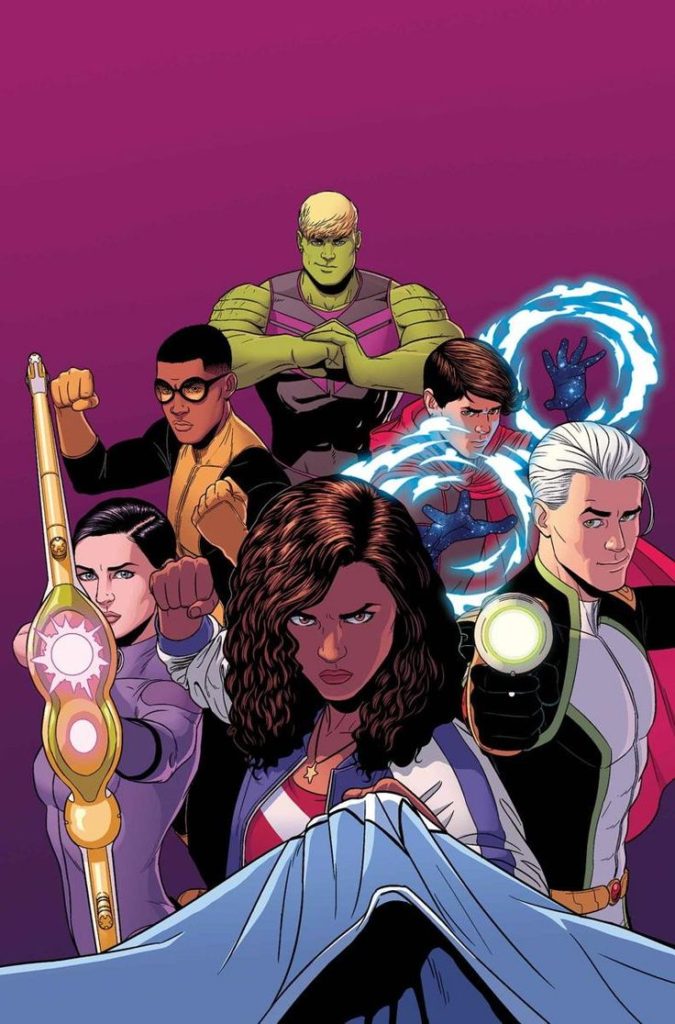
In 2013, Kieron Gillen and Jamie McKelvie launched a Young Avengers team that turned out to be all-minority and ALL QUEER. Wow. Art by McKelvie.

What is the implication when the gay friend or the black friend always dies? When a reader who identifies that way sees themselves being killed again and again in the media they consume, what reality do they begin to cultivate?

Do they believe their life matters?

Author Kieron Gillen recently addressed this in a response to a reader question on Tumblr; here’s an excerpt:

Reader: I (queer myself) understand an issue with such a lack of proper representation/appreciation for queer characters, especially with the recent discussions of queer deaths in media. Yet with WicDiv I see all characters as equally cared for, even in death. Just curious on your thoughts?

KG: There’s certainly been people who’ve found it upsetting and stopped reading the book for it, which we understand entirely. At least part of the reason our story front loads the “All these people are going to die” is that we want to put our cards on the table. … [I]n culture, we are so used to seeing bad things happen to LGBT characters because they are LGBT, that we can read negative intent into stories where bad things happen to them despite that they they are LGBT. I suspect she’s right.

(Like Whedon, Gillen’s approach works within the context of his stories – they’re typically stories about fear and loss where anyone might suffer a terrible fate, and he telegraphs that at the start. Also, not every one of his stories is one of loss – his brilliant Young Avengers is a mainstream book with the most diverse group of characters I’ve read in years and it doesn’t end in misery.)

Just as the solution to making a story thrilling isn’t constantly killing characters, the solution to the issue of increasing positive diverse representation cannot be plot armor for every minority character that walks into the story. That’s both patronizing and predictable. There is no good fiction without risk. To again reference the familiar horror trope, just as it’s no fun (and: awful) to know that the virgin will always live to see the end of the film, you don’t want to think a character is invincible just because she is latina or disabled or bisexual.

The solution to the representation problem isn’t just more representative casts – it’s more diverse protagonists (in addition to the representative supporting cast).

That’s not only because diversifying protagonists puts different people into the most-warranted set of plot armor – that of the star. It also strips the unfortunate association of punishment when we see other representative characters who do suffer or perish, since they are no longer the only representative of a minority (or even no longer the only representative of their specific minority).

In Gillen’s Young Avengers, for a major character to meet a grim fate they would have to be a minority character because the entire team was a minority in one way or another – a woman, a gay male couple, a pansexual male, a bisexual black male, and a gay latina daughter of a same sex couple. In fact, given the final panel, it might have be an all-queer superhero team – a sentence which makes me smile every damn time I write it.

That’s why representation matters. That’s why diversifying the casts of the fiction we consume is not “politically correct” or “diversification for diversity’s sake.” Representation matters because stories matter. We’re each our own protagonist, but many of us don’t see that reflected in the media we consume. When we have a world of comics books, movies, and television shows populated similarly to our actual worlds, then every person will own a key component of cultivating a reality where they matter and they are safe.

And, people exposed to those character who identify differently than themselves will begin to have it reinforced that “The Other” is not an expendable character in their story.

(This was originally going to be the introduction to a review, but it (a) turned into its own piece and (b) would seem to unnecessarily spoiler the outcome of the comic.)

Filed Under: comic books, cultivation theory, essays, Year 16 Tagged With: Buffy, diversity, Jamie McKelvie, Joss Whedon, Kieron Gillen, Representation, The Other, Young Avengers

Marvel introduced a black female Iron Man – is that a good thing? (Yes.)

July 6, 2016 by krisis

Today, Marvel and writer Brian Bendis broke the news via Time Magazine that at the end of the currently-running event “Civil War II” the mantle of Iron Man will be taken over by a 15-year old black MIT student named Riri Williams

(This IIM - 2016 - promois a major shocker, because the vast majority of fans assumed Riri’s introduction in the pages of Invincible Iron Man (visit the guide) – where she was reverse-engineering Tony Stark’s armor – was a set-up for her to take over the mantle of War Machine. Rhodey has become unavailable to carry that title due to the events of Civil War.)

Riri Williams as Iron Man is a very good thing. We do not have enough female heroes or heroes of color, and to see a that in a character who is both as she takes over the mantle of ostensibly Marvel’s most popular single hero outside of Spider-Man is a huge, visible step not only for Marvel comic readers, but for their film fans who this news will surely reach. To have Williams also be a female super-scientist when Marvel generally boasts only a handful is even more wonderful.

(The most prominent female geniuses of Marvel are Kitty Pryde, who is frequently shown to be nearly as genius as Beast; Valeria Richards, whose preternatural intelligence is partially attributed to super powers; the new Moon Girl; and Mockingbird, an oft-forgotten PhD) .

So Riri Williams as Iron Man is a good thing, right?

On the face of it, yes. Inclusion means representation. I love reading books about heroes that are women, and so does my daughter – also a girl of color.

However, there are some aspects of this character choice that have given some fans and critics pause, which I’d like to discuss here – three in particular. I’m very interested in your input. (Edited to add: Here is a post with similar critique from black writer Son of Baldwin, Here is another from black female nerd BlerdGurl.)

1. Minority legacy heroes are only useful until the original makes their return; then their marginalization can be worse than the average minority hero.

“Legacy Heroes” is a term applied to heroes that are the replacement or junior version to their original heroes. They are sometimes used by creators as an opportunity to change the gender or race of the character bearing the main mantle.. The easiest examples to give are from DC comics (Superboy, Batgirl, Wondergirl, etc), because Marvel simply isn’t known for this practice outside the past few years.

Let’s stick with Marvel, for the moment. For a brief time in the 1980s, Tony Stark could not serve as Iron Man and Rhodey Rhodes took over the title. Rhodey is the best possible example of a Legacy Hero – he was a dynamic, well-developed character long before he became Iron Man, and that means that he was able to continue to be featured even when Tony Stark returned.

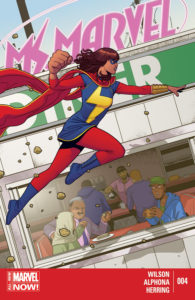
Ms-Marvel - 2014 - 0004As War Machine, he’s lead his own title on many occasions (though they are usually short-lived) and he’s and been a significant character in both comics and now films (though he’s frequently sacrificed as a narrative reason to make Stark feel bad, as has happened twice this year alone).
His time as a Legacy Hero made him more visible, but after being Iron Man he didn’t stay an A-level hero. The white guy bumped him.

Another terrific example is the relatively new Ms. Marvel, the Pakastani-American Kamala Khan (visit the guide). Kamala is a wonderful analog to the original Spider-Man as a new, unsure hero, and Carol Danvers is very unlikely to ever retake her “Ms.” hero mantle now that she is officially Captain Marvel.

Her books sell ridiculous amounts of copies and have been nominated for Eisners. She’s now an Avenger. Things are going well … but we’re only in year two.

There are examples that don’t go as well. At the end of the comics version of the original Civil War, Captain America appears to die, and Bucky takes over the mantle as Cap (visit the guide). His days as Cap are amazing – great, layered storytelling. When Cap came back they shared the mantle for a while before Bucky was spun back to being Winter Soldier, at which point he began to sink back into obscurity – and he’s a white guy who stars in movies.

As with War Machine, he’s now a character Marvel needs to periodically kickstart into a new title or team only to watch him sink again.

Despite those concerns, check out the amazing list of Legacy Heroes Marvel is currently fielding: [Read more…] about Marvel introduced a black female Iron Man – is that a good thing? (Yes.)

Filed Under: comic books, critique, essays Tagged With: Ant-Man, Brian Bendis, Captain Marvel, diversity, Hulk, inclusion, Iron Man, Kitty Pryde, Miles Morales, Moon Girl, Ms. Marvel, Representation, Riri Williams, Spider-Man, The Falcon, Thor, Tony Stark, Wasp, Winter Soldier, Wolverine

I (Kirsten Dunst movie) do not care about (Katy Perry song title)

July 5, 2016 by krisis

Like a David Foster Wallace novel, this is only going to make sense if you read the footnotes.

Like a David Foster Wallace novel, this is only going to make sense if you read the footnotes.

There are some things in the world that I deeply, deeply1,do not give any shits about but I am begrudgingly willing to experience through the eyes of a toddler. Holiday fireworks are one of those things, which makes it cosmically Alanis Ironic that I watched them without EV.

Fireworks sparkle, which is plus, but they are loud and incredibly pointless, which is a minus. I’m all about enjoying excerpts of them from a vantage point that is far away from where they are exploding (but not from the comfort of my own home, because that means that they are too close to home). Like, maybe I would enjoy them from a roof deck party with some delicious catering. In the fall. Wearing a jacket.

I do not want to see them up close. I do not want to hear the blaring low-fi music. I do not want to feel sticky with perspiration while watching them.2 I especially do not want to interact with any of the people also watch them.

Yet, there we were, past EV’s bedtime in a crowd of people who were waiting to watch fireworks. Well, really, there were E and EV. I was still parking the car, largely because we were told to do so by two bored-looking police officers.

“But, there’s no signs saying we can’t park here,” E retorted, when they told us we weren’t allowed to park on the side of the street we just parked on, alongside several other cars and absolutely zero signage about not parking there.

“Yeah,” one of them replied, “there ought to be some signs. Last year we didn’t have signs, and it was just a mess out here with all the fire trucks and ambulances on the street. There really ought to be signs.”

As a result of that total non-answer, I was parking the car in part of downtown Landsdowne I had never before seen while E and EV walked to the local high school’s field to watch the fireworks show for a suggested donation, which is another aspect of fireworks you do not have to deal with when watching them from afar.4

I parked my car Bowie-knows-where at the asterisk intersection of three different streets. Luckily, I could still see the top of the high school and so, after reciting a mnemonic for the cross streets to myself5, I began to thread my way through a series of one-way side streets toward the school, following the ever-growing trickle of people funneling in from other adjacent streets.

As I turned a final corner to reach the side of the field, I noticed that a section of fence was broken open. It curled back on itself. No one was anywhere nearby. I could just duck under the fence with my water bottle and my laptop and avoid paying to watch the fireworks I planned to studiously ignore while writing a blog post on said laptop and stealing sideways glances at EV.

I considered it for only a moment, because I generally do not break any laws or ordinances regardless of if there will be consequences (thus the re-parking of car despite lack of enforceable signs). Anyway, the field wasn’t especially full, so it felt wrong to avoid the cover charge. The crowd was sparse enough that some kids were turning long peals of cartwheels down the middle of it. I texted E with one thumb: Where AR U?

She texted back: Middle bleachers.

Funny that; there were no bleachers on the field.

I paced back and forth down its length, trying to imagine if she would refer to a small copse of folding chairs as “bleachers” and also wondering where you paid to enter before it occurred to me that the high school must have two fields6. This field, I realized as the fireworks began exploding overhead, constituted the cheap seats – you didn’t have to pay to sit here.

I half-jogged off the field, adjusted my speed based on the amount of perspiring I was already doing, and ambled around the school as the glittering opening salvo exploded over my head to the strains of a John Williams march. As I turned the northeast corner of the building I discovered the throngs of people that the parking situation clearly indicated were in attendance. I picked through the crowd until I reached a thick knot of folks standing between me and the the gate to the second field. They could all see and hear the fireworks perfectly well; some of them were sitting on blankets in the middle of the street. Beyond them, there was a sole man in a “STAFF” shirt, ostensibly acting as a ticket-seller, ticket-taker, and bouncer all rolled up into one. Past him was a field of even more people, with a marginally better view of the fireworks than the knot I was tied up in.

I was reaching for my wallet to pay just as another salvo launched. The fireworks were so loud. My head was already thrumming from the repeated booms. I think they were nearly as loud as my drummer Zina, and I won’t go anywhere near her without ear plugs or in-ear monitors. I took another look past the seller/taker/bouncer at the field. It was teeming with people and it was closer to where the fireworks were exploding. I don’t like either of those things. Yet, somewhere in the teeming mass was my wife and child, the latter of whom was either gaping in wonder at the man-made marvel of fireworks or sobbing inconsolably about how loud they were7.

I did some mental calculations. We were at least two Williams movements into the show. It would take me at least another three minutes to pick my way across the field in the darkness to the middle bleachers. How long could a fireworks show be? 10 minutes? 12? I wanted to experience EV experiencing the fireworks, but it seemed like I’d only make it in for a minute of them, tops. I texted E: Staying outside fence at this point.

There was a terrifically gnarled old tree across from the entrance to the field. I sat on its grasping roots at the fireworks continued overhead, now to the strains of “The Raiders March” from Indiana Jones. The march came and went. Fireworks were still exploding. I pressed a pinky into my ear and texted E: Kind of long, no? How is she holding up.

No answer. We were onto some other Williams now, but not Star Wars, although I cannot imagine why not. Certainly it’s not any more of a fireworks choreography cliche than Indiana Jones?

Long story moderately long, the fireworks went on for 30 minutes all throughout which I kept thinking, “surely that must be the finale, it cannot possibly get louder than that,” and then for another rogue minute after the music stopped that was either a dangerous misfire or an encore. Despite all the throngs of people, it wasn’t hard to spot E and EV afterwards to lead them back through the series of sides streets back to the car.

“Did you like the fireworks?” I asked EV, who looked blessedly un-tear-stained.

“THERE WERE EXTRA!” she answered. “EXTRA FIREWORKS!”

“At the end?” I said.

“YES, EXTRA FIREWORKS AT THE END AND I ATE A LOT OF SNACKS AND THERE WAS A MAN HE MADE A ‘V’ WITH THE LIGHT UP SWORDS LIKE THE ‘V’ IN MY NAME, ‘EV’!”

“Do you think she’s yelling because she was deafened?” I asked E.

“No, I think she’s just excited.”

I smiled. I might have missed the fireworks, but I definitely did not miss her reaction.8

Endnotes:

1. One time E and I bought the Kirsten Dunst movie Deeply for $5 at a grocery store and it was every bit as bad as that suggests and every time we refer to it (which is with surprising frequency) we say it in this lusty, throaty voice, like “deeeEEEEEEply,” and that is the voice with which you should read the italicized word above.

2. I’m sorry, I tried to make this into a green eggs and ham3 joke, but the meter never gelled.

3. I have yet to read Green Eggs and Ham to EV because all of the eggs we eat are green (either with spinach or pesto) and I do not want to put her off of them.

4. E has informed me that it is common to charge for premium seating for fireworks displays in the suburbs and I was like “For real for real?” Philly is so flat and the buildings are so low south of Chestnut that you can more or less see waterfront or sports complex fireworks from any rooftop and most back windows. Come to think of it, one of the big differences between city life and suburb life is that I no longer have a back window to climb out of onto a roof BUT ALSO that suspected burglars cannot flee across my roof either.

5. “Favorite pizza in college, a small and typically shortrun paperback booklet yet not a booklet but a man, marriage of those two concepts.” Or, Powelton, Chapman, and Union avenues.

6. Consider that I attended a city high school where the only two outdoor spaces were a caged-in roof and a tiny parking lot that you had to circle nine times to run a mile, vaulting trash bags along the way.

7. She is not much of a cryer and she totally hangs at rehearsal with Zina (while wearing ear protection, of course), but she is terrified of loud noises she can’t really get away from, like hand dryers in small public restrooms. A few weeks ago we were in a stall toilet in a tiny bathroom at the zoo when a gaggle of kids decided to play with the hand dryer, and that was maybe my second worst five minutes of parenting so far since I’ve been parenting full time (and the first worst was on that day, too).

8. Just a reminder that you don’t have to read every italicized work on my blog like”deeeEEEEEEply.” It was just that one time. I don’t want to leave you with the wrong idea. That’s not what I mean every time I use italics.

Filed Under: thoughts

your princess is in another castle

July 2, 2016 by krisis

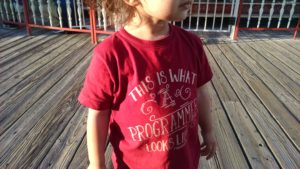
Without realizing it, each Wednesday for our weekly adventure I have gotten in the habit of dressing EV in her “This is what a programmer looks like” t-shirt from Django Girls, a non-profit that helps women learn to code. I hadn’t even realized the pattern until I scanned through our recent photos and saw the shirt again and again in the shots from Wednesdays.

I really love when EV wears that shirt. It’s awesome seeing examples of diversity of gender and race in the tech community, and there’s something even more powerful for me to see children implicated in that. That programmer woman you so desperately wish you could add to your team isn’t a magical unicorn who you could easily identify out of a lineup of women. She’s a person. She started out as a little girl. That is what a programmer looks like.

EV a few seconds after this week's "princess" incident.

EV a few seconds after this week’s “princess” incident.

However, this week I discovered an extra layer to adventuring in our “programmer” shirt when someone repeatedly referred to EV as “princess.”

We do not use the word “princess” in this household.

It was one of my early edicts of parenting even before a little girl emerged in the delivery room. I don’t like princess culture. Yes, they’re lovely and the stories are classic. It’s wonderful that princesses are increasingly portrayed as active, adventurous, and empowered.

However, even the most well-intended princess is still a princess. They’ve either won their status via a birth lottery that blessed them with royalty even as it cursed them with the prick of a spinning wheel or they romanced a prince who won a birth lottery and have now gained elevated status all thanks to love.

Neither is a message I feel needs encoding on a toddler whose brain is a sponge. Do we insist that every hero a little boy idolizes be a prince? No – more often the heroes presented to boys have earned their status through their actions, even if they are frequently working from the same book of “chosen one” tropes.

I see how EV absorbs every little input. She will reference minuscule details of events from weeks or months ago out of the blue with perfect recollection. It’s not special – it’s what toddlers do. What happens when you feed that spongey brain the message about birth lottery and marrying into status over and over and over again as the underpinnings of an otherwise innocuous and delightful story before they even understand how to consume stories?

Maybe nothing. Maybe just the pathological need to dress up in fancy dresses. That’s fine. It’s the other implications I dislike. Glam knows that plenty of today’s most successful women consumed these stories as kids, but why sandbag a little brain with confusing messages? I don’t think it’s ever too early to teach a doctrine of free will, nondeterminism, and consent, and princess culture can undermine all three.

I try not to get the claws out over a stray “princess” from someone speaking to EV the way I did at first (especially when it’s from a woman, because it lacks a leering aspect of condescension isn’t as present when it’s from someone of the same gender). This week I let the first mention from a man slide by. Then there was a second, and I bit my tongue. The third, delivered with him crouched down at eye level with EV, set me off.

“I think you meant ‘programmer’,” I said.

“Hmm? What?”

“You keep calling her ‘princess.’ She’s not a princess. Stop saying that.”

What I should have added was, “She’s not a princess now and she’s not aspiring to be one, either. So, you might as well call her ‘programmer.’ Or ‘doctor’ or ‘director’ or ‘engineer’ or ‘professor’ or anything, really, but certainly not the one thing she will almost certainly never be, because Kate Middleton is an extreme outlier. At the very least, can we settle on, ‘big girl’?”

“Or ‘president’.”

Filed Under: thoughts, Year 16 Tagged With: parenting, princesses

like a carnival ride, I kept swinging from side the side

June 30, 2016 by krisis

Last night, Mother of Krisis and I brought EV to the Wildwood Boardwalk for her first encounter with funnel cake, seagulls, and carnival rides.

(I think EV has already encountered white trash within the actual boundaries of Philadelphia. HEY-OH.)

(I kid, I kid. I actually have a deep, abiding love of the Wildwood Boardwalk as the sole interesting thing about being dragged to the beach multiple times each summer. It offers many bounties, like Curly’s Fries, Salt Water Taffy, and Lime Rickey, and it’s where I first encountered the six-player X-Men arcade game which birthed my obsession with Dazzler.)

2016-06-29 19.11.35Our first excursion was a set of Jeep-like buggies which rode up and down over invisible hills, encountering some bumps along the way. Since it was EV’s first ride and because I did not want to be the parent yelling soothing words at a crying child trapped on a ride for two more minutes, I opted to ride along with her in the comedically small car. EV sat in the driver’s seat, with me crouched awkwardly behind her.

(Mother refers to rides vaguely as “the attractions” in the manner of a jaded carny.)

I was immediately happy with my choice to accompany EV, because before the ride even began we were attacked by half a dozen seagulls. We hadn’t even had the funnel cake yet, but maybe she had one little crumb in her hair from lunch or something. Those fuckers are ruthless. My Tiger Father instincts kicked in and I formed a fleshy suit of gull armor around EV’s body, slapping birds away with the flats of my palms.

Actually, the seagull attack was a good introduction to the boardwalk. Not only did EV totally understand our need to eat funnel cake covertly later in the evening, but I think the gulls were scarier than any of the rides. After that, the the buggy bumps were only mildly alarming – possibly just because they were invisible.

The first time around, EV looked back at me, wincing. Not a good sign. “That’s the bumps!” I exclaimed, joyfully. “You have to get ready to steer over them.” The second time there was no wincing, but still an expression of great concern.

The third time there was maniacal laughter and an expression of pure joy. She would ride the buggies several more times – without me along in the backseat.

.

This morning we cast about for something to do that was not the beach, because my anxiety builds exponentially with each grain of sand stuck to my person. We settled on a tandem surrey ride on the boardwalk.

I enjoy the boardwalk by day – when I was trapped at the shore against my will as a kid I would walk its full, mostly-empty length and back while early risers hit the beach (a preview of my adult jogging on the Vegas strip while the prior night’s revelers were still passed out on benches).

The problem with this plan was the bit about working in tandem. Though Mother of Krisis is still convalescing from surgery, she thought she’d be able to occasionally contribute to the pedaling of said surrey. Perhaps she could have. The issue we encountered was that her feet could not even reach the pedals.

That meant I would be the sole pedaler for our 90-minute journey.

Let’s do some back of napkin math, shall we? A bit of web sleuthing reveals the surrey is 265 pounds, shipped. I’ll be generous and assume 10% of that weight is packaging. Mother of Krisis, EV, and I combined weigh 356 pounds. I carry a backpack that is another 15 pounds, at least, owing in part to the 100oz Camelbak full of water inside (for which I was very thankful).

That meant I spent 90 minutes locomoting over 600 pounds of Krisis Family Vacation up and down the boardwalk with only the power of my thick Italian thighs, all while small children on bikes and surreys powered by more than one person bobbed and weaved around us.

I wish I could say that writing this blog constituted the sum total of my subsequent physical activity for the day, but afterwards I swam laps while EV splashed around with her grandpop.

See: I really don’t vacation well. The only way to push through my mounting anxiety is to treat each day like I am on some sort of reality TV fitness challenge.

Filed Under: memories, thoughts

  • « Go to Previous Page
  • Page 1
  • Interim pages omitted …
  • Page 25
  • Page 26
  • Page 27
  • Page 28
  • Page 29
  • Interim pages omitted …
  • Page 502
  • Go to Next Page »

Primary Sidebar


Support Crushing Krisis on Patreon
Support CK
on Patreon


Follow me on BlueSky Follow me on Twitter Contact me Watch me on Youtube Subscribe to the CK RSS Feed

About CK

About Crushing Krisis
About My Music
About Your Author
Blog Archive
Comics Blogs Only
Contact Krisis
Terms & Conditions

Crushing Comics

Marvel Comics

Marvel Events Guide

Spider-Man Guide

DC Comics

  • Marvel Omnibus Announcement: Runaways by Rainbow Rowell and Predator vs. The Marvel Universe
    Near Mint Condition announced new Marvel omnis for January 2027: Runaways by Rainbow Rowell Omnibus and Predator vs. The Marvel Universe! […]
  • Patrons-Only: Crushing Comics Club Aftershow – Post Ranking X-Men Events Hangout and Q&A
    Every week after my Sunday stream I keep on streaming […]
  • Ranking the 100 BIGGEST X-Men Events & Stories with OneWheelChairX! | Crushing Comics Live
    Because you demanded it – my opinion on every […]
  • Patrons-Only: Crushing Comics Club Aftershow – Post-Marvel Omni Price Check Hangout and Q&A
    Every week after my Sunday stream I keep on streaming […]
  • Marvel Omnibus Price Check! | How much do Marvel’s most-obscure omnis cost online?
    Price check on Aisle Marvel! I’m doing a price […]
  • Patrons-Only: Crushing Comics Club Aftershow – Most-Wanted DC Omnibus Ballot Hangout and Q&A
    Every week after my Sunday stream I keep on streaming […]
  • My Most-Wanted DC Omnibus, 2026 Edition | Tigereyes Most-Wanted DC Omnibus Poll
    Because you demanded it, I’m here with my picks […]
  • Tigereyes Most Wanted DC Omnibus 3rd Annual Poll in 2026 Announcement
    It’s time to kick off The 2026 Tigereyes Most […]
  • Crushing Comics Live Aftershow 2027 Marvel Omnibus Fantasy Draft PicksPatrons-Only: Crushing Comics Club Aftershow – Post-Fantasy Draft Hangout and Q&A
    It’s time for another hour of Krisis uncut, […]
  • Crushing Comics Live 2027 Marvel Omnibus Fantasy Draft PicksMarvel Omnibus Fantasy Draft 2027 – Predicting Next Year’s Marvel Omnis (& you can too!)
    I’m back with an absolutely massive new […]
  • Patrons-Only: Crushing Comics Club Aftershow for Ranking Every X-Men Omnibus
    We’re trying something new! Yesterday after my […]
  • Crushing Comics Live - Ranking Every X-Men OmnibusRanking Every X-Men Omnibus, Ever
    Today, I woke up and chose violence… violence […]
  • Haul Around The World: 2026 So Far in Omnis, Epics, DC Finest, and more!
    It’s Sunday, and that means it’s time for […]
  • Tigereyes Most Wanted Marvel Omnibus 14th Annual Secret Ballot – 2026 Results
    Join me on Near Mint Condition along with Uncanny […]

Content Copyright ©2000-2023 Krisis Productions

Crushing Krisis participates in affiliate programs including (but not limited to): Amazon Services LLC Associates Program (in the US, UK, Canada, France, Germany, Italy, and Spain), eBay Partner Network, and iTunes Affiliate Program. If you make a qualifying purchase through an affiliate link I may receive a commission.