[Patreon-Nov16-Post-Bug][/Patreon-Nov16-Post-Bug]The first time I encountered a wordless picture book for children was Journey at my mother’s house nearly a year ago. Long before we had ventured to the library she was already cycling through books for EV every time she visited.
 I gave it a cursory page through and didn’t quite get it. EV didn’t seem to love it, either. I took away that EV wasn’t excited about wordless picture books.
Over the summer, E bought EV a wordless book called Pool. I was skeptical of it at first, recalling EV’s disinterest in Journey. Then, I watched something magic begin to happen. E kept making up the story of Pool, and EV began to interact with the story. Sometimes she interjected to add something from a prior telling, others she inserted her own details.
I took a turn reading it to her, and I noticed different facets of it than E, so my telling was a shade different. If I asked nicely enough and didn’t make a big deal about it, EV would even “read” Pool to me.
Pool was one of our most-read books during the summer. When E was listing off books from her want-list for our request list for the library and mentioned Journey, my ears pricked up.
I wondered – how would EV like the book now that she was older and more engaged in the shared creation of a story? Would Journey include both enough narrative and enough ambiguity to make for as interesting a read as Pool?
What a difference a few months made!
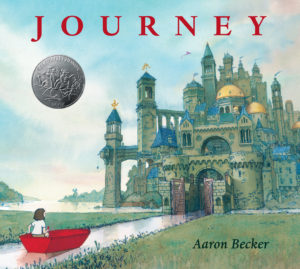
The Journey Trilogy: Journey, Quest, and Return by Aaron Becker 
CK Says:  – Try them!
Gender Diversity: Female protagonist; most other characters are male, although background characters are sometimes agender.
Ethnic Diversity: None, unfortunately
Challenging Language: None!
Themes to Discuss: imagination, fantasy, canals, cooperation
Reading Time: Depends on the reader! Between 4-15 minutes each, for us.
The Journey Trilogy by Aaron Becker is a beautiful, brilliant, fantastical trio of wordless adventure books by with a capable little girl hero, each with plenty of room for interpretation and expansion in the retelling. Becker proves himself an ingenious storyteller with an eye for detail and a knack for tantalizing ambiguity.
Journey is the story of a young girl who uses a piece of red chalk to travel to a fantastic world by drawing a door on her bedroom walk. In that world, she learns that the chalk can draw anything out of thin air.
After sailing through a town built on a series of canals, she encounters a group of soldiers flying in zeppelins are trying to catch a vivid purple bird. The girl tries to save the bird, but she’s captured herself, and the two work together so she can get free. The bird leads her to a door just like her own, except it’s the same color as the bird! On the other side, she is back in the real world down the street from her house, where she meets a boy with purple chalk.
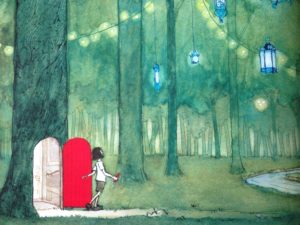 I could add so many more details to that plot summary, but none of them are verifiably true and that’s the best part of Journey. The story told by the series of gorgeous illustrations is never proscriptive, but it includes many hints to act as hooks for your imagination. The colorful chalk creations pop off the watercolor backgrounds.
The easiest example is the red chalk itself. The girl finds it on the floor of her room. Is it the first time she has encountered it? The natural urge is to say yes, as that fits with how stories like this one are usually told. However, she already owns a matching red scooter and red ball which she has been carrying around the house with her. Is it a coincidence that red is her favorite color, or had she created with the chalk before?
These points of interpretation abound in Journey, and they’re part of what makes it so fun in the retelling. Does the girl mean to steer her little red boat to the top of the highest canal? Is it she or the the bird who engineers the magic carpet that will fit through the bars of her cage? Where do she and the boy find the body of a bike that they draw wheels for at the end of the book?
That’s what makes Journey perfect for a small reader who can interact with you while you read. The details that EV noticed and questions she asked shaped out version of the story. Sometimes it’s a very plain, descriptive version that simply explains the action on each page. Others it unfurls in the telling like a florid fairy tale, full of little asides and descriptions of the girl’s inner monologue.
Journey would already be a surefire recommendation if it stood alone, but Aaron Becker extended the story into two additional books – Quest and Return – that are somehow even more captivating than Journey itself! [Read more…] about Children’s Book Review: The Journey Trilogy by Aaron Becker
 Stormwatch wasn’t immune to the widespread Image delays, but it had them more managed – its initial three-issue sprint was effectively a bi-monthly comic.
 Ron Marz’s story of a parallel dimension akin to He-Man’s Eternia would have been better suited across multiple issues. It’s difficult to understand Battalion’s actions as they occur over just a day, making it seem as though he was hypnotized or possessed by a sudden love interest. If that was Marz’s intent, I’d say the issue was great, but it’s unclear if we’re supposed to believe the relationship was on the up-and-up.
 Whatever the reason, I’m always giddy and than the steady gallop of the bass brings me back to earth as Chris Hughes tells me, “Welcome to your life…”
 Then there is the simplistic melody of the chorus, sketching little wedges across the stave on the minor lines as it leaps over and steps down across the tonic, b/ e \b \a, only treating us to a walk across the D on the single major line.
 In the gap, WildStorm quickly thrust WildCATs Trilogy, a three-issue mini-series from newly-poached Marvel young gun Jae Lee. It took just six months to complete (that’s sarcasm, by the way), and was accompanied by a single-issue Special #1 from Lee’s remarkable feel-alike protegé Travis Charest (which explicitly states that it fits prior to Trilogy).
